

Common Ragwort (Jacobaea vulgaris) in flower © MWT/Tamasine Stretton
Common Ragwort
Jacobaea vulgaris
For some, Common Ragwort’s pretty summer flowers are a sight for celebration, whilst for others they represent a murderous invasive which must be destroyed. So what is the truth behind this controversial plant?
Ecology
Common Ragwort is a native British plant, a member of the Composite family along with plants such as Dandelion and Daisy. It is biennial, meaning it germinates in the autumn, puts on leaf growth through the winter, then flowers and sets seed the following summer (between June and August). Normally the plant dies on completion of this cycle, but it can become a short-lived perennial when cut regularly or in areas of high soil moisture.
A single plant can produce up to 200,000 seeds which can lay dormant in the soil for as long as 20 years. The seeds disperse by two methods; the heavier (hairless) seeds simply fall beside the parent plant, while the lighter seeds (with tiny fine hairs) are carried away by the wind.
Where does it grow?
Common Ragwort grows particularly well on light to medium well-drained soils, and does not like wet, peaty or acidic ground. It can colonise most habitats, such as grassland, wood pasture and woodland, but does particularly well on bare or disturbed ground, which is why it is often seen growing in coastal dunes and overgrazed pasture.

Tansy; image by beauty_of_nature from Pixabay
There are other plants, like this Tansy, which can be confused with ragwort
Have I got Common Ragwort?
There are at least 25 plant species which resemble Common Ragwort, some of which are rare, so it is important to ensure correct identification. Young plants of Common Ragwort have low rosettes of divided leaves which are extremely variable, but are usually dark green in colour with a purple tinge, slightly glossy on the upper surface.
In their second or subsequent years, the rosettes mature and produce flowering stems between 30-100cm tall. The flowers are dense flat-topped clusters of yellow daisy-like flower heads, 1.5-2.5cm across. The leaves on mature plants are strongly divided into narrow lobes with the bases clasping the non-woody main stem. The flowering stems die back after producing seeds.
There are also other ragwort species; Common Ragwort (Jacobaea vulgaris) is the most common and widespread. The three other species you might spot in Montgomeryshire are Oxford Ragwort (Senecio squalidus), Hoary Ragwort (Jacobaea erucifolia) and Marsh Ragwort (Jacobaea aquatica).

Hoverfly (Syrphus ribesii) on Common Ragwort © Ross Hoddinott/2020VISION
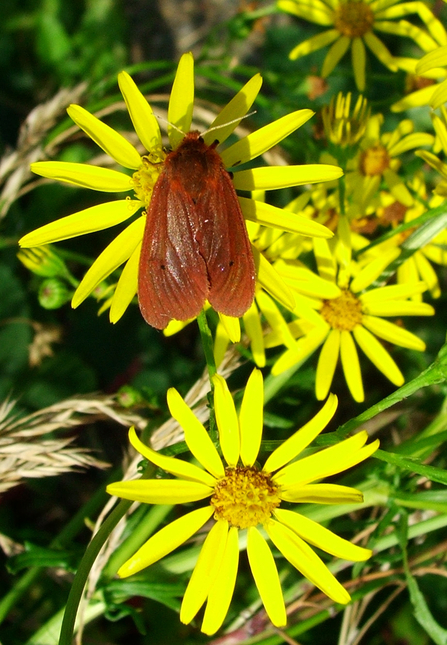
Ruby Tiger moth on ragwort © Tamasine Stretton

Gatekeeper butterfly on Common Ragwort © Tamasine Stretton
Ragwort is great for wildlife
As a long-established native plant, Common Ragwort provides food and shelter for a great variety of wildlife. It is an important nectar source for many insects, and some species of fly and beetle have larvae that feed and live inside its seed heads. In fact, it is known that at least 30 insect and 14 fungi species live on nothing else, and about one third of those are nationally scarce or rare. Ragwort is also a great plant to have in the garden because it supports numerous insects that control aphids.
Probably the most familiar insect associated with ragwort is the Cinnabar Moth, a striking black and red moth which is often disturbed from the low vegetation on which it spends the day. The black and gold caterpillars of this moth gorge themselves on ragwort; they start off by eating the developing seeds before moving onto the leaves. If in sufficient numbers, Cinnabar Moth caterpillars make effective biological control, as they eat all parts of the plant.

Common Ragwort plant with Cinnabar moth caterpillars © Tamasine Stretton
So why the bad press?
Ragwort is despised by many, because it contains potent toxins which can cause potentially lethal liver failure in many grazing animals. Livestock affected include horses, ponies, donkeys, deer and cattle, especially in young animals; sheep appear to consume Common Ragwort without apparent injury.
When alive, the plant has a foul taste, and animals rarely touch it, unless there is little else to eat. The plant is still toxic when dead, but it loses its bitter taste, so animals are not so easily able to detect and avoid it. The main cause of ragwort poisoning is through animals eating contaminated hay, but problems can also occur on over-grazed land where ragwort can thrive on disturbed ground.
It is important to understand that there are many toxic plants growing in the countryside and in our gardens, including those, such as tomatoes, which we eat parts of. Whilst there are certainly situations when ragwort can present a problem to livestock, the negative impacts of this plant have been exaggerated.
Legal status
The Weeds Act 1959 makes the control of Common Ragwort (Senecio jacobaea) the responsibility of the occupier on whose land the ragwort is growing. The Welsh Government (WG) has produced ‘Code of Practice to Prevent the Spread of Ragwort’ (NWSI 2026 No.54) which provides excellent guidance.
The code does not seek to eradicate ragwort, only control it where there is a threat to the health and welfare of animals; it recommends that ragwort only needs to be controlled where it occurs on, or near grazed land or land used for hay and poses a demonstrable risk to livestock.
Control
The presence of Common Ragwort often reflects underlying grassland management issues rather than a need for repeated direct control. Ragwort is most likely to establish where there is bare ground, over‑grazing, poaching or other disturbance. Effective ragwort management is therefore not just about removing plants, but about understanding risk, choosing appropriate methods, and addressing the land‑management conditions that allow ragwort to persist.
Methods of control vary depending on where the ragwort is growing, and how much of it you need to control; repeat treatments over several years may be required. Hand-pulling is effective on a small area, if the plants are pulled up before they flower.
Cutting or topping may temporarily reduce the risk of flowering and seed production, but it does not usually kill the plant. If carried out repeatedly or at the wrong time, cutting can actually encourage regrowth and prolong the plant’s presence on a site. For this reason, cutting should only be used as a short‑term risk‑reduction measure, for example where immediate removal is not practical, and should be followed by longer‑term management to address the underlying conditions that allowed ragwort to establish.
Herbicides can be a time‑efficient method for controlling Common Ragwort over large areas, but should not be used without careful consideration of potential effects on the environment, and on human and animal health. Any herbicide use should be appropriate to the site and situation, and carried out in accordance with guidance and legal requirements. Follow‑up treatment may be necessary where plants re‑establish or where control has been incomplete. Herbicides should not be relied on as a standalone solution and are most effective when combined with longer‑term grassland management.
Whatever method chosen, the ragwort will require careful disposal to prevent further spread from the seeds, as well as accidental poisoning. Again, disposal will depend on the amount to be disposed of, and local resources, but incineration may be the best method. Care should be taken when handling or storing pulled plants, as ragwort remains toxic when dead.

Bumblebee taking nectar from Common Ragwort flowers © Tamasine Stretton
Don't see Red... see Yellow!
Although ragwort is poisonous, the risk to animals is minimised by careful management of hay meadows and by avoiding over-grazing. Ragwort is very important for wildlife and causes no harm on land not grazed by, or near livestock, or used for making hay. Control is costly and time-consuming, and invertebrates need a continuity of a reasonable quantity of ragwort plants, so control should be limited to where it is strictly justified.