
Photo: © MWT/Lottie Glover
Grassland Communities
One of the most important wildlife habitats on Earth, grassland is vital for nature, biodiversity and the environment, but it is threatened. As part of the Grassland Communities project, between 2024 and 2026 we worked with local farmers and landowners big and small to help them make improvements to their grasslands, for nature, climate resilience and to benefit farm businesses.
Grassland Communities was funded by the Nature Networks Programme, and was delivered by the Heritage Fund, on behalf of the Welsh Government.

Grassland Communities continued the theme of bigger, better, more joined up areas of nature, to benefit not only wildlife, but communities too. Its forerunner, Green Connections - a Powys-wide collaboration between Wildlife Trusts - proved the demand from landowners, groups and individuals for more support to act positively for biodiversity and the climate. Grassland Communities will focus on improving the remaining grassland network, a habitat which has suffered catastrophic historical losses, and remains under serious threat. Key to the success of this is working with the farming community, making use of a partnership with Nature Friendly Farming Network (NFFN).

The Grassland Communities project will be focusing on lowland pasture in the mid-Montgomeryshire area
With a focus on lowland pasture in mid-Montgomeryshire, we worked with the Nature Friendly Farming Network to provide advice and support to farmers and smaller landowners in the project area. Meanwhile events will showcase nature-friendly farming in action, share knowledge and skills and create a landowner support network.
Grasslands with different species of grass and other flowering plants boost insect diversity, which in turn support greater numbers of birds and mammals. A varied grassland also has deeper roots making it more drought-resistant and therefore able to hold more water and store more carbon! It’s good for livestock that feed on it, and wildlife that could benefit include rare waxcap fungi, the Pearl-bordered Fritillary butterfly, Skylark and Meadow Pipit, to name but a few.
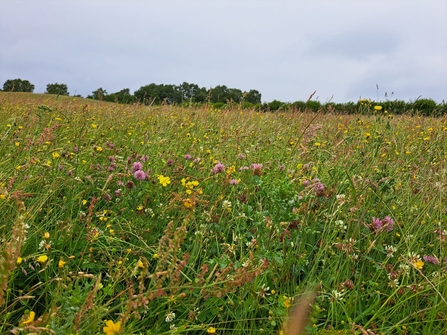
Grassland is incredibly important wildlife habitat, supporting a huge range of different plants, insects, birds and mammals Photo: © MWT/Lottie Glover
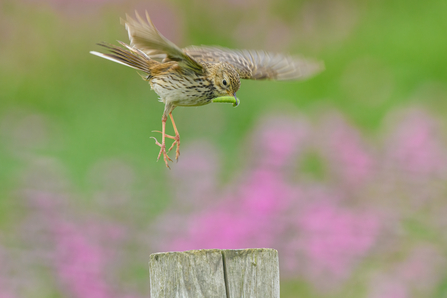
The Meadow Pipit is a bird species that could benefit from the Grassland Communities project Photo: © Lee Myers
What did we want to achieve?
- To increase the quality and improve the management of existing unimproved and semi-unimproved grasslands, including Local Wildlife Sites, in the project area.
- To boost grassland connectivity between these sites, through habitat creation and appropriate land management.
- To provide advice, training and free surveys to the local community and create opportunities for peer-to-peer learning and innovation in nature-friendly, sustainable farming.
- To raise awareness of the potential contribution that healthy grassland ecosystems can make to climate mitigation and adaptation, and prevent the loss of grasslands to inappropriate development, including afforestation.
- To support and inspire people to create more areas for wildlife and to connect to what’s already there, through the lens of grassland habitats and species.
- To enhance wellbeing through nature-engagement.